
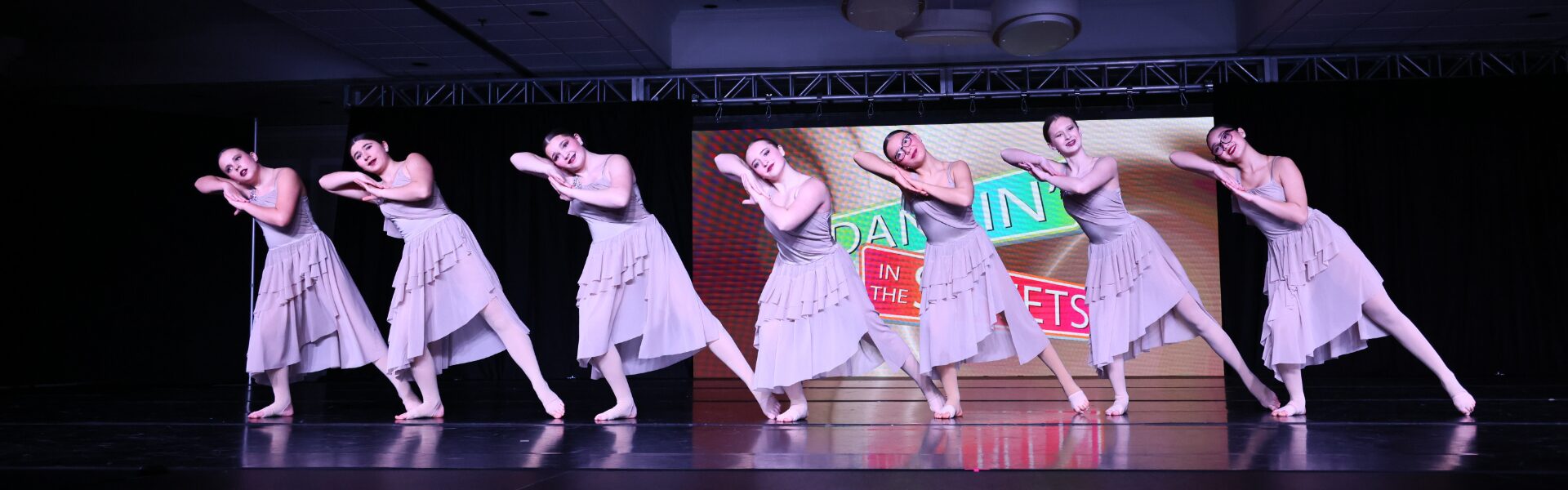
01 of 4
Evenings
Several classes a week, most weeks, from late summer through to the spring. Add extra rehearsals in the weeks before a competition.


Competition team
Several classes a week, a season of regional and national competitions, and a group of dancers who show up for each other. It asks a lot of a family. For the right dancer it is the best thing they will do all year.
Interested in joining the Competition Team? Tell us about your dancer and we will help you understand the next step. Nothing to pay and nothing to sign.
Read this first
We would rather you decide against this now than in February. So here is the honest version, before anything else.
Several classes a week, most weeks, from late summer through to the spring. Add extra rehearsals in the weeks before a competition.
Competition weekends are long. You leave early, you wait around, and you are often still there in the evening. Some are far enough to need a hotel.
Tuition, plus costumes, plus entry fees, plus travel. It is a real line in a family budget, and we will be as clear as we can about the costs you should expect before you commit.
A routine has holes in it when one dancer is missing. The rest of their group feels every absence, which is the part that makes the commitment real.
Is this your dancer
They are already dancing, pick up choreography very quickly, and ask to stay for the next class. That dancer is ready to be asked for more.
Some dancers love the scoring, the deadline and the clean run through. Others find it takes the joy out. Both are fine, and only one of them belongs on a team.
If they are new to dance, if the schedule is already full, or if they are doing this because a friend is, recreational classes will serve them better. Ask us next year. Nobody thinks less of a family for waiting.
The season
The year begins with team placement and setting the routines for the competition season. From there, dancers train in technique classes, rehearse their routines, and work together to refine the details that make a group performance strong.
Competition weekends run through the winter and into the spring. Dancers perform, receive scores and feedback from the judges, and bring that feedback back into the studio as they continue to develop throughout the season. The year finishes with our annual recital alongside the rest of the Peak music and dance program.
Team dancers train on StageStep sprung floors, designed to provide cushioning and support through the repeated jumps, landings, and movement that are part of intensive dance training.
This term
Team technique classes are the foundation of the routines. Competition Team schedules are based on team placement and the classes each dancer needs for the season.


Team faculty
Jillian is co-owner of Peak Music and Dance and Director of the Dance Program. She works with dancers in both the recreational program and the team.
See Jillian’s open timesMarin is Artistic Director at Peak Music and Dance and works intensively with the team.
Tuition
Team cost is not one number and we will not pretend it is. We will give you a clear picture of monthly tuition, costume costs, competition entry fees, and the travel expenses you can reasonably expect before you commit.
Team parents
Jillian has created such a positive and supportive environment where the girls truly encourage one another and grow together as dancers and as people. In a world where so many kids learn through pressure and criticism, Jillian teaches through positivity and encouragement, and it is amazing to see the confidence and closeness that creates among the girls.
Our experience with the dance faculty has been incredibly rewarding. Watching the dancers support one another on and off the stage has been one of the most meaningful parts of this journey.
Jillian and her team have created such an incredible program for my daughter to grow, not only as a dancer but also in confidence and discipline.
Before you audition
Several evenings a week in the studio through the season, plus extra rehearsals in the weeks leading up to competitions and the competition weekends themselves. Competition Team is a significant commitment, and we want families to understand the time involved so they can decide whether it is the right fit for their dancer.
They keep their recreational classes and we tell you, specifically, what to work on for next year. An audition here is not a verdict on whether they are a dancer. It is a judgement about whether this particular year is the right one, and dancers who are told to wait a year very often make it the next time.
There are several costs to consider: monthly tuition, costumes, competition entry fees, and travel. We will walk you through the costs involved before you commit so you have a clear picture of what the season will require.
Sometimes, and it depends entirely on the scheduling conflicts. Bring us the other schedule before you audition and we will look at it with you. What does not work is finding out in January that your dancer will miss a rehearsal every week, because the routines are built around who is dancing where.
Competition dance is demanding, which is why we take conditioning, technique, and recovery seriously. Conditioning is part of the training, not an afterthought, and technique is taught separately from rehearsing routines so dancers can develop the strength and control they need. Our dancers also train on StageStep sprung floors, which are designed to provide cushioning and support during jumps, landings, and other high-impact movement.
Also at Peak
Weekly dance for kids and teens, real technique and no pressure.
Creative movement for toddlers and preschoolers.
Ballet, tap, jazz, hip hop, lyrical and acro, from toddlers to adults.
One first step
Tell us about your dancer and what you are looking for, and we will help you understand the next step.
Nothing to pay and nothing to sign. We work out the fit first, then you decide.
Have a question? Ask us a question or start with recreational.